About Me

My photo
Peginterferon-Ribavirin, Failed it twice. Incivek, Failed it. Sovaldi Olysio, failed it. Harvoni, failed it... Transplant Patient Zepatier and Sovaldi...we'll find out!

Monday, August 31, 2015

Caveat Emptor

It's almost as American as it is Roman. "Let the buyer beware."

In the US we advocate this a strange notion of preparation. So when it comes to healthcare, we've put ourselves in an awkward position.

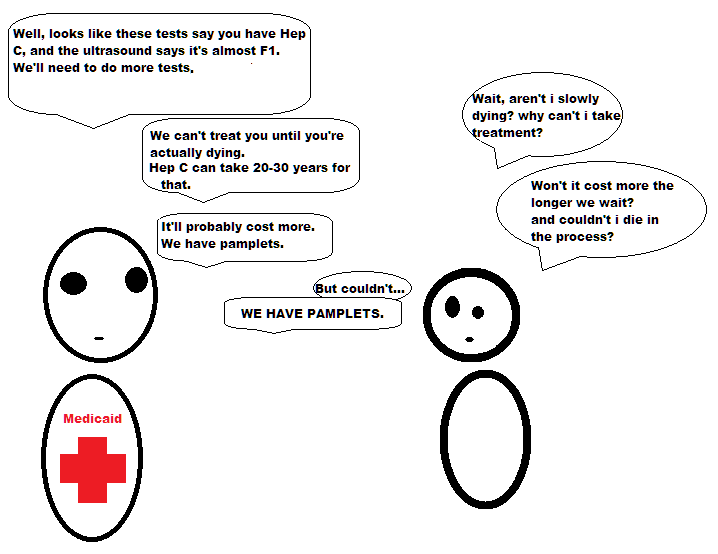
I came across some inspiration from imgur 


Roamin' Phrases.
Welcome to the United States of America, land of the free, home of the brave.

Laws pay me no mind, I'm a freelancer in the cracks and crags, live with the hacks and hags of society.

The idea and principle that I navigate the labyrinth under the legalities means that I am temporarily live on the outskirts of the law.

I'd love to be protected, but the shield costs money I don't have. Tickets as if I'm going somewhere from different states, different counties.

Last notice! Papers pile high, on the table, gladly pay it all if I were able.

What's the law to those in the labyrinth? Here we chase freedom in hopes of scraps that fall from societies favor and become available to us.

In here, you watch your step, there's emergency care but you'd better have insurance. Make all checks payable to the feet that blot out the sun.

Insurance agencies at every corner down here, the world knows the labyrinth exists. Tens of millions live in it, they'd be blind to ignore it. Each agency employs us, telling us what to do and how to live if we want their pittance.

Money is free speech, money can travel the world to exotic accounts in the Caribbean, or the Alps.

Money holds thousands of insurance employees hostage as it demands more vacation hours.

Bills, from sneezes, lawsuits from companies claiming ownership of the breeze down here.

They already own all the hot air.
So we run after false profits, don't run in the labyrinth, you'll trip. A broken ankle will cost you an arm and a leg. "But I've got insurance" I told them. Apparently my network only extends to one doctor 30 miles away, my cell phone has better coverage.

But it needs to, it's got ads to sell me, and apps to sell me. Already paid for the hospital when it was built, that was for the pre-release, who knew there'd be hundreds of day one DLC?*

It's dark here, I wish we were outsiders, I wish we're the outliers.

Lines of string litter the floor, looking for the exit, ridiculous you can climb out anytime. These walls aren't that high.

Climb over the bodies that make up the surface, these walls are made by those before us.
The last of someone's sweat, blood, straw build the bricks of tomorrow.

Up there, the sun shines on monuments dedicated to the austerity of the posterior. A history that never was, made of legends men told to justify their lordship.

The labyrinth is the foundation of their pomp society. Seeds of knowledge drop from trees too large to cut down. The library's branches spread ever outward. Knowledge of my nudity does not protect me from the cold.

Awakened from my slumber by a solitary beep.
The IV is out of fluid, it's the second time this week.
More concerned about coverage of my cell network
Litigiously inspected every goddamn perk.
No mind, insurance, nine to five times as much.
Didn't realize my car would cost less than a crutch.
Didn't know it's Kaiser's face on the hundred thousand bill.
But when I first saw the thing, I passed out from the thrill.
Labyrinth obscure me as a number on a sheet.
Thirtieth time, in debt, someone will die this week.
Worked hard all my life, to move up someday.
The maze; a debtor's prison, as there's hell to pay.
This is my last straw, they'll be bricks no more.
It's time to be unburdened by Caveat Emptor.


*Pre-release or pre-purchasing in the video games industry refers to paying for the game before it comes out. Day One DLC refers to Downloadable Content which is available at an extra cost when the game is released. Day One DLC can consist of expansions to game-play, or can be what was prior-to-release assumed to be part of the content of the program itself. It's basically a really complicated Bait and Switch.

Wednesday, August 19, 2015

Inertia and Inhibitors

In the last year a great deal has changed for patients with Hep C. Multiple treatment options with minimal symptoms which take half as long or even less, a renewed focus on testing, and a healthcare overhaul have all been at the forefront.

We're also seeing a trend of high cost medication, with a round of treatment costing twice as much as the poverty rate for a family of four.

Medicaid clamped down to only approve the sickest of patients, many states requiring permanent liver damage before treatment can be an option.
States will begin to get better pricing when election season is done, but depending upon how the TPP goes, it could be better or worse.

Private insurers have similar policies, taking advantage of the discounts offered to patients and often denying coverage.

Cure rates for most treatments remain 90+% and more treatments which use Protease and Polymerase inhibitors are on their way. (Protease and Polymerase are two different approaches in destroying the virus, they combine to be far more effective than alone/with Ribavirin)
So what happens when you're not part of the 90+%?

When you've spent years of your life becoming familiar with health insurance, FDA studies, and in hospitals/clinics. When you grow up memorizing hallways, bizarre wallpaper, medical pamphlets and illustrated guides, all of this seems pretty normal.

I've pressed on past each failure, and usually each time they've found a more specific reason why it didn't work.

I have failed five different treatments, and recently I found out why.

I have three mutations which combine to prevent protease inhibitors from working properly.

Originally I was under the impression that I had the q80k polymorphism (it's a weird mutation that can prevent protease inhibitors from working without a combo of meds) which was an accurate assumption until better tests were able to pinpoint why Harvoni did not work.

While failing one protease inhibitor does not mean another may fail, it does reduce the chance of success significantly.

The combination of mutations I have prevents Ledipasvir (the protease part of Harvoni) and most NS3/4a inhibitors from working as intended.

NS3/4a inhibitors = protease inhibitors= Olysio/Simeprevir, Daclatasvir, Ledipasvir, etc...

So what happens now?

Nothing. Now that I know which drugs I cannot take, it means searching the web for any potential studies which are for Treatment experienced, f4 decompensated patients who cannot take protease inhibitors.

Why I say nothing, is because that's presently what I've found. I'm certain that at some point they'll find a new way to attack the virus but until then my life waits.

I'm uncertain how long I'll live. Depending on my luck, I could have a few years still until transplant.

Transplant is an extension, the likelihood that my liver will decompensate within a year is about 50%, as I will re-infect it. I could push a few more years past that, but it's hard to say.

To say that this isn't depressing would be absurd.

When a chilling reality like this hits i accept it, i embrace it, i understand it, and i forget it.

I accept that my health outlook is grim and will ultimately defeat me.

I embrace the problem and refuse to define myself by it.

I understand the precautions and limitations I face are guidelines, not rules (but seriously though, some are still rules).

I forget it, because the focus isn't on it, my focus is on me.

To move forward i must turn inward and find small bits of motivation to get me moving.

An object in motion will stay in motion.

Thursday, July 30, 2015

The Locked Warehouse Doors

Before Viekira Pak, Sovaldi, and Harvoni...

There was Incivek (telaprevir) the $83,509 Drug

When it came out it was heralded as a wonder drug, because it nearly doubled the (SVR)cure rate of HCV meds at the time.

It cured my mother, but while she was on it she had multiple transfusions and her anemia was controlled by ProCrit (a red-blood cell boosting drug). It was later found out to have been a direct contributor to several deaths, and thousands who took it were left with permanent skin damage regardless of success of treatment or not.


When the drug was pulled from the market, there was a feeling in the HCV community. When a cure with rates that good is pulled, even if it carries a black-box(may cause death) label from the FDA, some would risk it.

I nearly died while on it due to my anemia and bursting esophageal varices. From that point on, like many F4 patients I was barred from using Interferon for new treatments.

The term warehousing became popularized with HCV patients. In 2013 Sovaldi and Viekira Pak were undergoing trials and it was believed by many that there would be a host of new drugs being released within a few years (referring to 2014/2015)


The existing treatments' side effects were troublesome, and the results were poor in late 2012 after Incivek became taboo. Patients who could have taken those treatments opted not to because when your options are to feel terrible for 48 weeks and 50% chance, or wait a year or two for a 12-24 week treatment with a 90%+ chance...it's not hard to see the appeal. Especially when you consider that majority of the deferring patients would have been in the F0-F2 category, which has minimal symptoms.


Now, back to 2015. Sovaldi, Harvoni, Viekira Pak and other partner medications like Olysio and Daclatasvir have been released. Every Pharmaceutical is throwing in their hat. Merck is even entering the all oral ring early next year with a grazoprevir elbasvir combo similar to Harvoni. Drug makers are ensuring that each of the drugs targets specific genotypes, and it's not purely scientific. In doing so it allows them to rush the FDA approval process for what's called "Breakthrough therapy" designation. The result is a whole lot of new HCV drugs that treat lots of genotypes of HCV.

Which means that all of those HCV patients can get treatment, right?
Not quite. Because at it would turn out these companies are using Incivek's pricing model.

Let's talk business for a second what makes that price point? The price won't always be as high as it is now. In a few years the drugs will lose their patent's exclusivity 

Usually this means that the drug needs to profit as much as it can within the first five years before generics can start being licensed. Patents still protect a drug from copycats for 20 years from date of filing. So they'll still make large profits until the patent expires.


The Research and Development (RnD), litigation from patent trolling, and acquisitions are also costs to bear in mind. Acquisitions can cost hundreds of millions to billions of dollars. Most Manufacturers acquire smaller labs who are/were producing HCV meds. After that, it's direct injections of capital for RnD expansion until its market ready. Then the lab gets to use the distribution methods, sales channels and brand recognition of a major name. Make no mistake, they're making billions off these deals, but they're also billion dollar risks.

With lots of high priced drugs on the market, both AbbVie (Viekira Pak maker) and Gilead(Sovaldi/Harvoni maker) offered direct to discounts to consumers. AbbVie started to patent troll Gilead in attempt to slow down the impending juggernaut Harvoni. Insurers and Medicaid/Medicare had to figure out a way to handle the tidal wave of some of the largest groups of HCV patients warehoused. The restrictions are now at such a point where those patients still warehoused now find the door locked by health insurance restrictions.

This is the Locked Warehouse Door.

The reality of new HCV patients is one of the locked warehouse door. For those who await treatment, either existing or pending treatments, they must wait for the bureaucracy of the key. Hopefully by then the price of that key becomes affordable.

In an effort to help categorize the different Tweets regarding HCV, consider using the hashtag: #LockedWarehouseDoor when tweeting about health insurance or Medicaid restrictions and high-cost HCV Meds. Help remind pharmaceutical companies, insurance companies and lawmakers that the "warehouse" of HCV patients are dying to get out.

if you were denied Sovaldi, Harvoni, Viekira Pak, or any other new HCV med, if you had to go through lots of hurdles for treatment; I urge you to tweet about them with the hashtag: #LockedWarehouseDoor.

Tuesday, July 28, 2015

Today is World Hepatitis Day.

Over 400 million people around the world suffer from a form of Viral Hepatitis. In the United States Over 36,000 people die every year from liver disease.

Around the world over 4,000 people die every day from Viral Hepatitis.

It's known as the silent epidemic, because for years it hides, not displaying any symptoms.

I spend a lot of time talking about Hepatitis C, because it's been eating away at my body since I was born.

But this post is different. It's mostly about the other two major forms of Hepatitis.

Both Hepatitis A and B have vaccines. While Hepatitis A is unlikely to kill you it will make you sick...for months. Hepatitis A can run its course and rarely develops into anything worse. In an otherwise healthy adult Hepatitis A will be like the worst flu you've ever had. In a person with a compromised immune system, it can be life-threatening.

Hepatitis A is transmitted typically via the fecal-oral route. Like C. Diff and other forms of food poisoning you'll get it from (feces)tainted food or water.

Hepatitis B usually develops into a chronic illness. Like Hep C it is a silent killer often slowly destroying the liver. There are treatments for Hep B, but since there is a vaccine, focus is more on prevention than treatment. Like Hep C(HCV) there is no cure, while someone with HCV can be cured by clearing the virus through Sustained Viral Response, this is not the case for Hep B.

When someone is diagnosed with Chronic Hep B it is (for now) a life sentence. Treatment for it often is required as a daily pill to prevent the viral load from increasing and causing more damage.

This year the WHO announced its first ever treatment guidelines for Hep B.


If a person with Chronic Hep B or Chronic Hep C is exposed to Hep A, the effects can be crippling.

Hep A and B vaccinations are available for infants, and can be taken at any time/age and still be effective.

Every year we move leaps and bounds toward better prevention methods, better testing and better treatment options for all forms of Viral Hepatitis.

World Hepatitis Day is about taking preventative measures against Viral Hepatitis, getting tested, and getting treatment.


I am a person with Hepatitis C Genotype 1a Q80k Polymorphism with a decompensated stage two liver.
I was put into the stage four category two years ago.


One year mortality rates

As this chart shows, my odds get slimmer ever year. I'm lucky though.

This year I have an ~89% chance of complete liver failure. If a new treatment option does not appear by the fall, I would not be surprised to need a transplant come winter.

A transplant for individuals with HCV or HBV is not a cure. It's far from it. When the transplant takes, I will re-infect that new liver.

My odds after that do not exist.


Because there isn't a large enough sample size who have done this at such a young age. I've heard estimates of 10-15 years, as I'll likely re-infect the new liver soon after it takes.


Oh! Hello there! Still reading?

Wondering where that 400 million comes from? Well If you look at CDC data it'll point to WHO, if you look at WHO fact sheets it either doesn't say or points to the WHO, The Lancet, or CDC data...So i did some digging. (The Lancet article is about deaths, not in total)

400 million people have Viral Hepatitis which comes from about 240 million for HBV, and 130-150 Million for HCV.

Plus or minus 10 million is a silly think to throw out there when their own fact sheets would have them add up to 370-390 million.

240 million is actually a ten year old low-ball estimate.
The number is based off something called an empirical Bayesian hierarchical model. The number was about 223 million back in 1990, but a 2005 estimate had the number at that 240 we see today. 

They just haven't updated fact sheets to respond to the increase, and i have yet to come across new data. While i lack the knowledge to employ the model it's reasonable to assume millions more for HBV.

So what about HCV? that crazy range of 130-150 million people? The numbers are all over the place estimates go as high as 180 million.

Hopefully we'll see a study soon with application of the model so that we can have a more accurate picture.

So I'm sad to say that 400 million is probably a conservative estimate.

Sunday, July 26, 2015

Jaundice, HCV, and Me.

I haven't spent much time on here talking about myself lately. I've been wrapped up looking for more information regarding insurance, and trying to analyze the political climate and new concerns about HCV.

So I'll be posting or presenting a handful of potentially peculiar posts until my next doctor's appointment in August. Because It's time I get you up to speed. On moments, with friends, because they're important. Because they help me better understand how I approach this physical and emotional battering ram, with small and subtle gestures.
This past weekend, we had installed a new bulb in the kitchen. It's a bright white bulb, the light had been malfunctioning for a while. Since most of the bulbs in the rooms are soft white and shades of yellow, things appear their actual color.

Most of our lights are soft white or yellow intentionally.
My bilirubin has been bizarrely high since I graduated high school. I've always had a shade of yellow to my skin and dull eye whites. I've learned to obscure it with color, lighting and getting a little tan.

My brief experience with extreme jaundice confirmed what I assumed would be the case.
Call me.. Golden-eye.
I stick out. Especially as the jaundice also extends to the whites of my eyes. Normally now my eyes have a hazy yellow instead of a typical white sheen. When the jaundice is bad, it's jarring.

When they see it most people can tell I'm probably sick, but it's hard to understand. As it's the only characteristic they see and besides that, I appear healthy.

I was in the kitchen when a friend of mine noticed my jaundice from a few feet away. Concerned, he asked me about it. It's something I can't see without a mirror. It's something I can't tell because I see things with a slightly yellow wash. A camera is best, a selfie under a white light with my eyes wide open will tell me how jaundice my eyes are. I can compare it to something I know to be white.

Panic,
Fear, anxiety rushed into me within a second. I'd have to go back to the hospital. I'd be there for a while, and this could happen at any moment.

It was a sobering realization, that any day, I could wake up look in the mirror and say "Shit. Where the hell are my Go-Bag, Keys and Wallet?"


As much sadness as it brings me, as much fear as it brings me, dwelling on hang ups slows down my response. A response that's crucial and could involve whether I live to make it to the hospital or freeze up and delay timely medical assistance.

For a moment I stuttered, I realized I'd forgotten to take my meds that day. I downed them quickly and I took the photos under two different white lights, compared them to white objects. I was normal, well for me anyway. It was simply the case that my friend had never seen the more pale part of my farmer's tan  under the bright white light.

I'm rather relieved that this was the case. But I realize that it is very likely that I will become more and more jaundice as I approach the need for a transplant.

But I guess it's good to know that at least I'd have survived The Battle of Bunker Hill. So I got that going for me, which is nice.

The Battle of Bunker hill is where the phrase "Don't shoot until you see the whites of their eyes." came from.

Monday, July 20, 2015

Who cares about the TPP anyway?

Since I was diagnosed with Hep C (HCV) when I was 13...
I ignored the problem, grew detached and depressed.
At 18...I fought the problem, the idea that I was sick, that I could live a normal life.

At 22...I lost.
At 23...I lost, I thought the key was to improve myself, to focus inwards.
At 26...I lost, I became more honest, more humble and focused on helping others.
At 28...I lost, I put my heart into text and hope that my growing disabilities would not hamper my new found advocacy.
At 29...I lost, I have never been more inspired by those around me than ever before. I have never been more hopeful and afraid of the amazing potential we now possess.

With all of the new meds, what should I be afraid of?

Myself. I am not even 30, and I have end stage liver disease. I should rephrase myself, this is what I am afraid of:  anyone getting to F4 cirrhosis for no reason.

I am already too late. For those coming close, who are denied treatment for the thousands upon thousands of people who could be cured but will not be.

Present restrictions of new HCV meds will force people on Medicaid to wait until they have irreparable damage before they even have access in nearly a dozen states.

Normally states would attempt to grab discounts from the pharmaceuticals to give more people access to the meds they need. In fact the ACA gives the states better leverage to do just that.

So what's the deal?

Even Carve-out options right now are being held in reserve...why?


Joseph Stiglitz has been critical of the deal for it's expansions of 'Big Pharma' patents.

States can't lobby for decent rates right now, because pharmaceutical companies can hold out and wait for the results of the TPP.
If the TPP is successful it will create a very different atmosphere for pharmaceutical companies.
Presently states use their Medicaid groups to get discounts. This works by a simple principle: The more people in your healthcare group, the better discounts you can ask for.

There are hundreds of healthcare groups in the US. The biggest groups, like Medicaid, can ask for the best discount. The TPP will allow for stronger and longer patents, limiting access to generics. Which means Medicaid will have to coax discounts of brand name pharmaceuticals more often and for longer periods of time.
This alone will mean less effective discounts, higher medical costs, and higher insurance premiums.
Let's not forget about the hundreds of millions of people who will be trying to do the same thing Medicaid is doing...at the same time.

The biggest groups get the discounts.

Japan has a nationalized healthcare system with a population of around 125 million people.
Canada has a nationalized healthcare system with a population of around 35 million people.
Millions more live in New Zealand, Singapore, Australia, Peru, Mexico, Brunei, Vietnam, Malaysia, and Chile.

Each group would have to compete with each other for discounts, which means every single group gets less of a discount. Which means more restrictions, and less access.

The loss of bargaining power would healthcare prices in every country to rise. Including countries who aren't members of the TPP.

We hoot and holler about Gilead making billions over the past year with new HCV meds...but that's nothing compared to what all pharmaceuticals will make if the TPP passes.


We don't just lose money. We don't just lose Jobs.
The TPP will indirectly hasten the deaths of hundreds of thousands of people with Hepatitis C.

Thursday, July 2, 2015

Medicaid Barriers to New HCV Meds like Sovaldi

We have the power to end Hepatitis C in my lifetime. And yet...here we are.
When someone gets diagnosed with Hepatitis C (HCV), they don't all react in a similar fashion, we are a hodge-podge of strangers who have one thing in common.

Some turn to faith, Some discard religion, others ignore the growing problem, and many still have no idea. There are so many different ways we're spread, but we all agree on something.

Treatment early prevents the problem from surfacing.

So the ACA won and is here to stay, the supreme court ruled in favor 6-3....but what did we win?

Presently certain medical groups have combined forces with government red tape, stopping access to a cure for millions.
In order to truly go into the depth of this issue I need to stress certain facts and logic.

Hepatitis C is an epidemic of potentially horrific trouble, in a modern society it can travel  undetected. Poor policy presents potential population problems.

Drug use like this is uncommon, he is a modern shitty Typhoid Mary of sorts.

The key is early detection, early "cure" (Sustained Viral Response).
  • It follows that the early someone is cured, the less likely they are to accidentally spread the virus.
  • It follows that the earlier someone is cured the less likely they are to see their quality of life diminish.
  • It follows that the earlier someone is cured the more likely they will be healthier overall, allowing them to be more productive in the workforce.
  • It follows that a child whose parent has HCV, or vice versa will not have to bear the strenuous financial burdens that come with advanced liver disease alongside the emotional hardships. 

Remember that a disease infects an individual but affects a family.
When disease affects families, millions of families, it impacts the nation.

and now we have the power, the technology to cure (SVR) over a hundred million people of HCV.

Cure rates are in the 90% range, from new Direct Acting Antiviral (DAAs). We're familiar with the names: Sovaldi, Veikira Pak, Olysio, Harvoni, etc. (and more are in the pipeline from big guns like Merck and Johnson & Johnson)

It's why the World Health Organization has been so vocal about HCV recently. It's why we've seen more news about HCV float to mainstream in the past two years than in the previous ten. It's why the CDC has been building up their Know More Hepatitis campaign.
It's Hope for over a hundred million people worldwide. In the US our chronic hepatitis C population is around 2.7-3.9 million people.

For reference San Diego County has a population of 3.2 million people, Same as Phoenix Arizona. There are more people with HCV than the entire population of the state of Mississippi, Iowa, Connecticut, Utah or Nevada.

There are many options regarding HCV treatment, and certain treatments will have better "cure"(SVR) rates than others for different genotypes.

The longer someone is infected with HCV the more damage it will do, the longer the treatment takes, the less likely the cure rate.

Lets look at Metavir scores, as it's a common liver metric.
Medicaid reimbursement criteria for sofosbuvir (Sovaldi) based on documented level of liver fibrosis stage required for reimbursement.

As a person with F4 cirrhosis I took 24 weeks of Harvoni, and could have possibly been extended because I am the rare case of failure.

Someone with F2/F3 can often take 12 weeks.

Someone with F0 can often take 8 weeks.

Medicaid is the government sponsored healthcare in the US for those making 138% of the federal poverty level or lower.
Which is about $16,242 for a single person, or $33,465 for a family of four.

Medicaid is presently placing restrictions on access to HCV meds: in the form of requirements and testing.

A decent liver panel and Fibrosis scan can tell a doc what they need to know. Biopsies and other function tests are often not necessary for F0 patients.
What is happening in Medicaid is the restriction of access to cures that will best fit their genotype, by requiring you to have a certain level of damage, and pay for the unnecessary tests in the mean time.
At those limits of about $16,242 and $33,465, people can see a max out of pocket of $812 and $1,673 respectively.
But as people in Medicaid rise above the 150% of the Federal Poverty level (FPL) the costs become nearly unmanageable. as they'll quickly hit the out of pocket maximum, and when your take home is at ~$1,400 income per month, $1,059 over one or two months is hard.

Wait. Go back to that picture.
F4 cirrhosis is borderline liver transplant.
Those four states require permanent liver damage before they treat you.

It's even more troublesome for people at 100%-138% federal poverty level, If they are presently uninsured, and subsequently diagnosed, and then require Medicare. They could see costs in the tens of thousands for the test alone if they were to take them.

Presently different states can impact how fast a person hits that max out of pocket. For those of you unfamiliar with the nuances of Medicaid there are laws in nearly half of the states called carve-out or carve-in laws. The fundamental difference is that Carve-out has a larger rebate, and thus costs less to both the patient and taxpayers. Carve-in is more intricate offering more options by using the Medicaid Managed Care Organization of the patient's choice. This often results in allowing the insurer to select the methods and restrictions on medications, as well as create a faster operating network to minimize delays in coverage. It's higher price-point benefits the Insurers, and costs marginally more.


The ACA helped expand coverage via Medicaid.

So what can we do?

Well the ACA's advancements will continue growing in the existing US healthcare market, and Insurers will become more open to its use once the tax policies are ironed out by some future law. Presently the ACA's Medicaid expansion has given Managed Care Organizations better tools for price reduction.

But there's a whole 'nother aspect of the price point.


Hep C (HCV) would likely benefit by being carved-out, however it does not have a high degree of outreach or education, and it has lots of expensive options. Many combinations of different RXs and drugs which vary by genotype.
To make it more shitty, it is cheaper overall for everyone if the treatment is offered earlier, before serious liver damage.

But since we're dealing with politicians arguing bottom lines...
Let's forget that apparently we're not dealing with the Silent Epidemic (HCV) fast enough, the quality of life lost, the loss of work-hours, the pareto loss
(pareto loss is an overall shrinkage in market capacity), The affect it has on a family unit, and the potential 10% job loss due to the stigma

AIDs felt this frustration over a decade ago, when looking at Carve-outs because of increasing costs. 

A carve out policy for HCV is more likely to positively impact HCV, so long as Medicaid focuses on comprehensive care for HCV patients. (and governors are looking at it just a few months ago.)
The case for the now larger pool of Medicaid recipients would be able to help ensure better discounts than five years ago. (South Carolina started one yesterday! July 1, 2015)
But as we see with Medicaid's current restrictions on HCV care and the gratuitous testing requirements, the bottom line is where it counts.

WE HAVE THE POWER TO END HCV IN MY LIFETIME. And yet...here we are.

Presently, HCV information and advocacy is growing, the stronger we are linked together the better we can help each other.

When my liver became decompensated and I entered the transplant list, I saw the world through comprehensive care for the first time, prior to this I had elements of compressive care offered to me, but not required. When HCV comes into your life, the future can be cloudy, comprehensive care can help this. Depression, Anxiety, Fatigue, to Stress, the stigma and nature of HCV combine with chronic hepatitis, can show early on in ways you don't notice at first.

It's hard to see behind unopened doors. There is need for therapy beyond groups and our ever growing online communities, I hope that within the next few years we can see the landscape changing.